


Eismusik is an installation in which melting ice becomes a co-producer of music. The ice is positioned in various shapes above or on different sound-producing objects, so that the droplets formed as it melts produce sounds. Through an exploration of natural processes such as climate change, a performative sound space is thus created.

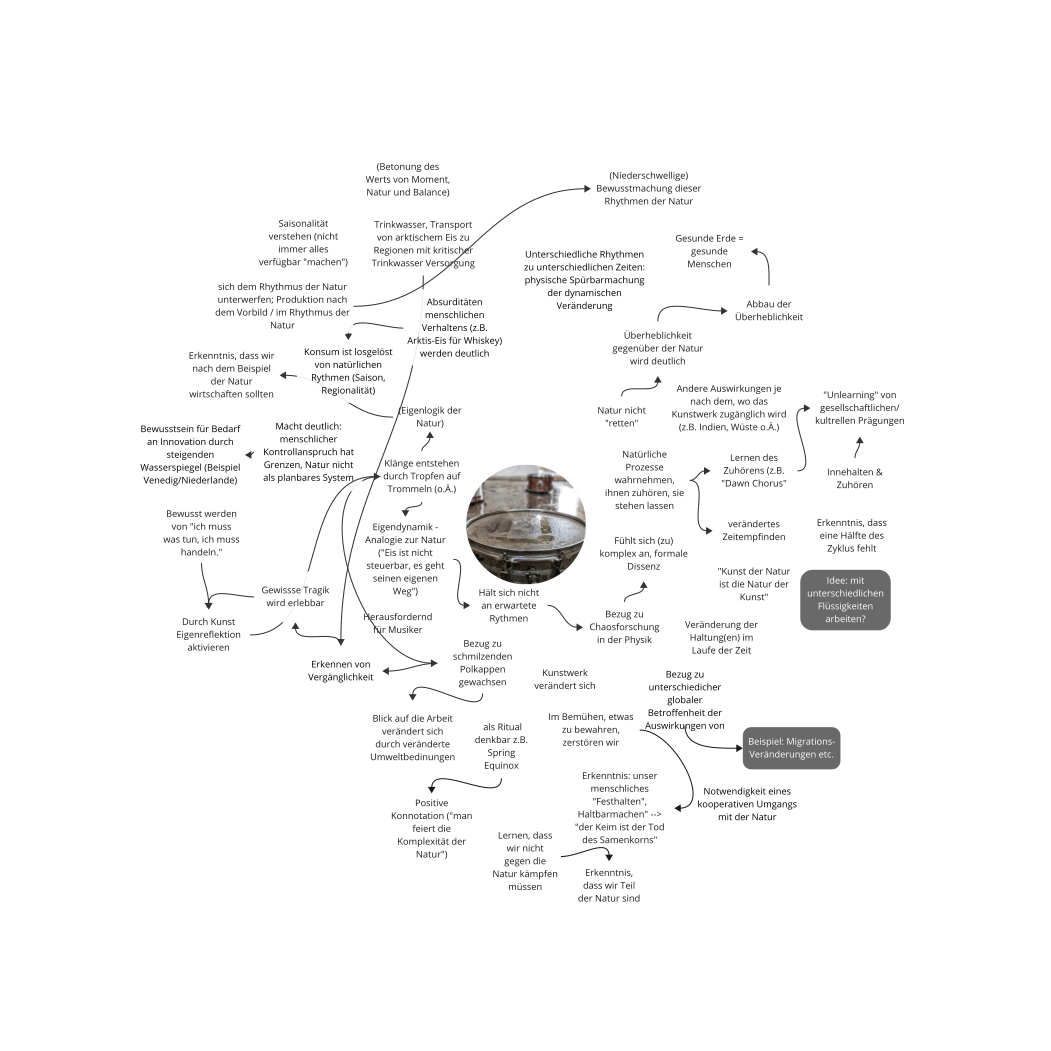
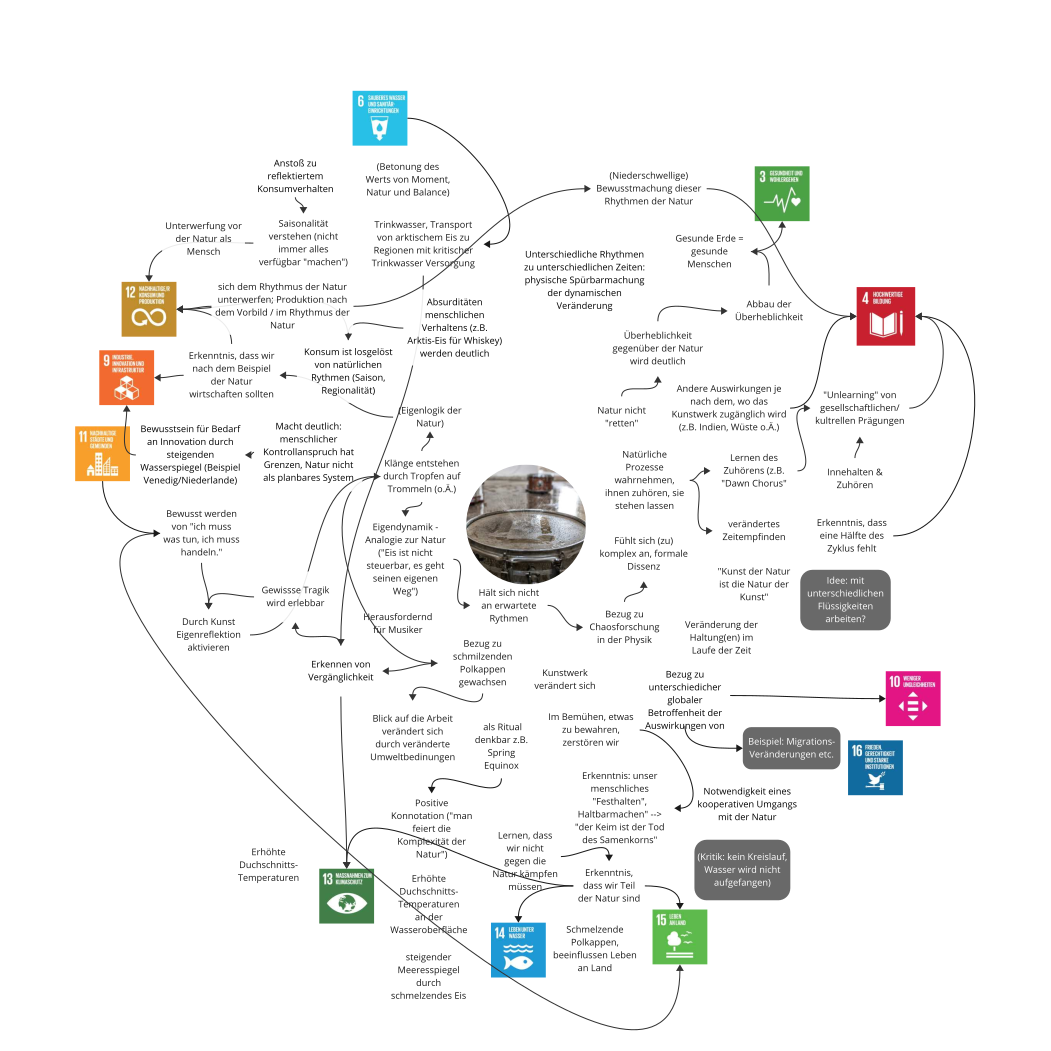
On March 24, 2026, an interdisciplinary group of natural scientists, designers, artists, sustainability researchers, and art educators analyzed the potential impacts of Eismusik using the Map/ing Sustainability method. The artist himself took part in the discussion. Several participants had previously experienced the installation at least once.


During the discussion, it became clear that Eismusik can open up spaces for experience in which perception, pausing, and conscious listening take center stage. The discussion group emphasized that this work can encourage people to “listen to natural processes, observe them, and let them be.” In this way, it facilitates moments of slowing down and reflection that can have a positive impact on individual well-being (SDG 3).
A key potential was identified in the area of informal educational processes: The sensory-aesthetic experience of nonlinear, constantly changing rhythms can open up entry points to complexity that go beyond purely cognitive knowledge transfer. It was emphasized that the ice “simply does not adhere to fixed structures of tempo and rhythm, but drips as it pleases,” thereby disrupting familiar patterns of order and thought. This could be understood as a process of relearning that sharpens perception and enables other, less established forms of understanding (SDG 4).
At the same time, the participants perceived a special emotional quality in the work. The relatively long time many visitors spent there suggests that the installation opens up spaces of experience that go beyond the obvious and in which deeper levels of human experience might be addressed. Furthermore, the idea was put forward that the work could take on ritual-like qualities by being interpreted not only as a warning about the consequences of climate change but also by facilitating a positive, sensory connection to nature—for example, by “celebrating the complexity of nature by truly internalizing this rhythm.”
The discussion focused on the extent to which Eismusik can influence specific Provisioning Systems. However, some presentations drew connections to broader social and economic structures. For example, it was emphasized that the installation could encourage people to question dominant notions of growth and progress.
Several participants pointed out that current economic logic is often geared toward “more and more, further and further,” and thus diverges from natural processes (SDG 8). Eismusik could trigger a shift in perspective here by making it tangible that decline, dissolution, and transformation can also be integral parts of development. Furthermore, it was emphasized that the installation’s openness and process-oriented nature could make alternative, cycle-based ways of thinking visible. This point was sharpened in the discussion with the observation that social systems often fail to think cycles through to their conclusion and may thus overlook central aspects of ecological and social interconnections.
During the discussion, it became clear that the work focuses on natural processes and uses them as the starting point for its aesthetic impact. By using melting ice as a sound source, the installation draws directly on natural processes and makes their dynamics tangible within the space. The discussion group saw in this the potential to make ecological relationships perceptible not only in the abstract, but also in their temporal, material, and sensory dimensions (SDGs 14, 15). In particular, it was emphasized that the interplay of temperature, material, and melting behavior points to interactions within natural systems and can thus foster an understanding of their fragility and dynamics.
At the same time, it was noted that the ecological dimension of the work—for example, in relation to climate change and melting ice—is not necessarily the primary focus, but rather, for many viewers, may only become apparent over time or in the context of societal debates. The installation could thus initially engage viewers through aesthetic experience—listening, observing, and lingering—and, building on that, facilitate associations with global ecological changes.
Furthermore, it was emphasized that “Eismusik” makes fundamental natural principles—such as the cycle of creation and decay—tangible. This opens up spaces for reflection on human interventions in ecological systems as well as on a relationship with nature shaped by the logic of growth. The work could encourage people to question the decoupling of social practices from natural rhythms. In doing so, it provides impetus for a deeper engagement with natural rhythms and a renewed connection to them.